How AI, IoT, and Blockchain Are Reshaping Agriculture in 2026–2027
Explore how AI, IoT, blockchain and agricultural RWA tokenization are changing precision farming, supply-chain traceability and AgriTech in 2026–2027
Why the next phase of agricultural innovation depends less on individual technologies and more on connecting farm intelligence, supply-chain information, and real-world economic activity.
Agriculture does not have a shortage of technology. It has a challenge turning fragmented information into decisions that create measurable value.
A soil sensor can report moisture levels. A satellite can capture changes in vegetation. An AI model can analyze historical weather patterns. A blockchain network can preserve a record of transactions.
But none of these capabilities automatically makes a farm more productive, a supply chain more transparent, or an agricultural asset more valuable.
The real transformation begins when information can move reliably from the field to the people, systems, and decisions that depend on it.
As agriculture moves toward 2027, this distinction is becoming increasingly important.
- For farmers, the question is whether technology improves decisions without adding unnecessary cost or complexity.
- For agribusinesses, it is whether digital infrastructure improves operational visibility, traceability, and coordination.
- For Web3 innovators, it is whether blockchain-based systems can demonstrate utility beyond token issuance.
Explore where AI, IoT, and blockchain can create value, what the latest industry evidence tells us, and which implementation challenges deserve more attention.
1. Agriculture's Digital Transformation Is a Data Problem Before It Is an AI Problem
Consider a typical agricultural value chain.
Production information may be recorded by farmers, environmental conditions monitored by sensors, crop movements documented by logistics providers, and quality information maintained by processors.
Each participant may use a different system.
The result is not necessarily a lack of information. It is a lack of connected, reliable, and usable information.
That distinction matters because AI systems depend on the quality, relevance, and availability of their underlying data.
A model trained on incomplete or poorly localized agricultural information may generate recommendations that appear precise but do not reflect actual field conditions.
The World Bank's Digital Progress and Trends Report 2025 identifies poor rural connectivity, limited digital infrastructure, high implementation costs, and inadequate high-quality data as important barriers to agricultural AI adoption.
These challenges suggest that the next stage of digital agriculture will require more than sophisticated algorithms.
It will require:
-
Reliable agricultural data collection
-
Interoperability between connected systems
-
Localized analysis and decision support
-
Accessible mobile interfaces
-
Clear data governance and accountability
AI can make agricultural information more useful, but the information must first be trustworthy, relevant, and accessible.
2. The Water Challenge Shows Why Precision Agriculture Matters
Water management offers one of the clearest examples of where connected agricultural intelligence can address a real operational need.
According to FAO's 2025 AQUASTAT data, published in January 2026, agriculture accounts for approximately 72% of global freshwater withdrawals.
The same update reports that renewable freshwater availability per person has declined by approximately 7% over the preceding decade.
These figures highlight the growing importance of efficient agricultural water management.
However, precision irrigation is not simply about installing moisture sensors.
It requires translating field measurements into practical decisions.
How an IoT-enabled irrigation workflow can operate

The farmer assesses the recommendation and determines whether irrigation is necessary.
This workflow can support more informed irrigation decisions. Actual water savings, however, depend on crop type, climate, soil conditions, irrigation equipment, and implementation quality.
The objective is not to automate every decision.
It is to improve the information available when decisions must be made.
3. AI in Agriculture: Where Does It Create Practical Value?
AI is increasingly being explored across crop monitoring, disease identification, yield estimation, resource planning, and agricultural logistics.
Yet these applications differ considerably in their data requirements and operational complexity.
A useful distinction is between predicting a condition and improving an outcome.
For example, an AI model may estimate the probability of crop stress.
That prediction becomes operationally valuable only when it is delivered in time, understood correctly, and connected to an appropriate response.
Agricultural AI should therefore be evaluated through practical questions:
Does it improve the timing of decisions?
Does it reduce unnecessary monitoring effort?
Does it help identify conditions that require attention?
Can its recommendations be validated against field observations?
And importantly, does the value justify the cost of deployment and maintenance?
4. Blockchain in Agriculture: Traceability Is More Than Recording Transactions
Agricultural products pass through multiple organizations before reaching consumers.
Farmers, aggregators, processors, distributors, exporters, and retailers may all generate information about the same product.
However, these records are often maintained independently.
This creates challenges when stakeholders need to establish product origin, identify affected batches, review processing history, or reconcile distribution information.
Blockchain can provide a shared, tamper-evident record of selected supply-chain events.
But there is an important distinction.
Blockchain can help preserve the integrity of recorded information. It cannot independently guarantee that the original information was accurate.
A credible agricultural traceability system therefore requires both reliable data capture and appropriate record governance.
What a connected traceability workflow could look like

Each stage can contribute information to a connected digital record.
Depending on the system architecture, blockchain may be used to preserve event references, timestamps, verification evidence, or cryptographic hashes, while sensitive or high-volume information remains in conventional databases.
The potential benefits include improved information sharing, easier record reconciliation, and more consistent product-history retrieval.
However, implementation also requires agreement on data standards, participant permissions, verification procedures, and responsibility for correcting inaccurate information.
The technology alone does not solve these organizational challenges.
5. The Economics of Agricultural Technology Are Changing
One of the most important questions for 2026–2027 is not how many digital technologies a farm can adopt.
It is how much operational value those technologies can generate relative to their total cost.
Consider a connected monitoring system.
The initial investment may include sensors, gateways, software integration, and installation.
But the total cost also includes:
-
Device calibration and replacement
-
Connectivity and data transmission
-
Software maintenance
-
Data storage and processing
-
User training and support
-
Cybersecurity and system reliability
For AI-enabled systems, additional costs may arise from model evaluation, updates, and ongoing data-quality management.
For blockchain applications, organizations must also consider integration, transaction processing, governance, and record-verification costs.
A better framework for evaluating agricultural technology

A technology investment should not be judged solely by the sophistication of its features.
It should be judged by the decisions, processes, and outcomes it can improve.
6. Where Real-World Assets and Web3 Enter the Agricultural Economy
Agriculture represents an extensive physical economy involving farmland, equipment, crops, inventory, commodities, and commercial transactions.
Real-world asset tokenization explores how rights or interests associated with eligible physical or financial assets can be represented digitally.
In agriculture, possible applications include digital representations of eligible asset interests, structured participation models, and more transparent records of certain transactions.
However, tokenization introduces questions that are fundamentally different from crop monitoring or supply-chain traceability.
These include:
Asset rights: What legal or economic interest does a token represent?
Verification: How is the underlying asset identified and independently validated?
Governance: Who is responsible for maintaining the asset and its associated records?
Regulation: Which securities, property, financial-services, or other laws apply?
Liquidity: Is there an actual market where participants can transfer or sell the token?
Risk: How are agricultural, operational, legal, and market risks disclosed?
Tokenization does not automatically create liquidity, ownership rights, or investment returns.
Those outcomes depend on the legal structure, underlying asset, operating model, and market conditions.
For agricultural Web3 ecosystems, this makes real-world integration especially important.
A credible model must explain what happens beyond the blockchain.
7. The Next Opportunity: Connecting Agricultural Intelligence With Digital Infrastructure
The greatest opportunity may not lie in AI, IoT, or blockchain operating independently.
It may lie in their ability to support complementary functions within a connected agricultural ecosystem.
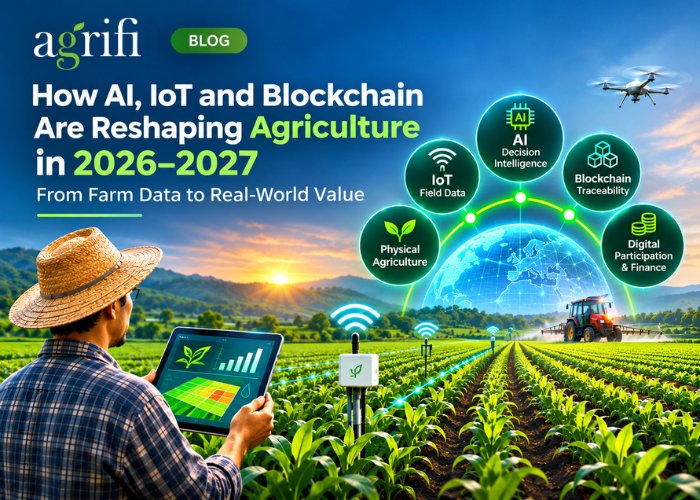
Consider the following conceptual architecture:

Eligible asset representation, governance mechanisms, and financial services where legally and operationally appropriate.
Each layer addresses a different challenge.
IoT helps capture information.
AI helps interpret it.
Blockchain can support record integrity and coordination.
Digital financial infrastructure may enable additional services or participation models.
But the effectiveness of the ecosystem depends on how these layers are integrated, validated, and governed.
8. What Agricultural Technology Leaders Should Prioritize in 2027
The next phase of agricultural digital transformation will likely place greater emphasis on implementation quality rather than technology adoption alone.
Five priorities deserve particular attention.
1. Build reliable agricultural data foundations
High-quality field and operational data are essential for meaningful analytics, automation, and traceability.
2. Design for real farming conditions
Solutions must account for rural connectivity limitations, device maintenance, affordability, local languages, and varying levels of digital literacy.
3. Measure operational outcomes
Projects should establish baseline performance and evaluate improvements in relevant metrics such as resource use, response time, record completeness, or administrative effort.
4. Connect systems without creating new silos
Interoperability and common data standards should be considered from the beginning.
5. Distinguish technological capability from commercial readiness
A working prototype is not necessarily a validated agricultural product, a scalable business model, or a compliant financial service.
These distinctions are especially important where AI recommendations, asset tokenization, and decentralized finance intersect.
9. AgriFi's Vision: Connecting Agriculture With Emerging Digital Infrastructure
At AgriFi, our vision is to explore how AI, IoT, blockchain, and Web3 can contribute to more connected agricultural systems.
This means looking beyond individual technologies toward the relationships between field intelligence, supply-chain information, verifiable digital records, and real-world agricultural activity.
The opportunity is to develop an ecosystem perspective in which agricultural data can become more accessible, information can be more consistently connected, and emerging digital infrastructure can support new possibilities for participation.
Realizing that vision requires practical implementation, credible validation, appropriate governance, and measurable outcomes.
The focus should remain on the agricultural problems technology is intended to address.
The Future of Agriculture Is Not Just Digital, It Is Connected.
AI can improve the interpretation of agricultural data.
IoT can make field conditions more visible.
Blockchain can support verifiable records and digital coordination.
Web3 can introduce new models for representing assets and organizing participation.
But the presence of these technologies does not guarantee better farming outcomes.
The defining question for 2027 is whether agricultural technology can move beyond collecting and recording information to helping people make better decisions and coordinate more effectively.
That is where meaningful digital transformation begins.
At AgriFi, we believe the next generation of agricultural innovation will be shaped by this connection between physical agriculture, digital intelligence, and trusted infrastructure.
Explore AgriFi: https://agrifi.tech
FAQ
How is AI transforming agriculture in 2026?
AI is being used to analyze agricultural data for applications including crop monitoring, yield forecasting, pest detection, and irrigation decision support. Its effectiveness depends on data quality, local conditions, and validation.
What is the role of IoT in precision agriculture?
IoT devices collect information about conditions such as soil moisture, temperature, and environmental changes. Connected applications can use this information to support monitoring and timely decisions.
How does blockchain improve agricultural traceability?
Blockchain can maintain tamper-evident records of selected supply-chain events. When combined with reliable data collection and verification processes, it can support more consistent access to product-history information.
Can farmland be tokenized as a real-world asset?
Certain legally defined interests associated with farmland may be represented through digital tokens, depending on the jurisdiction and transaction structure. Tokenization alone does not establish legal ownership, guarantee liquidity, or produce returns.
What is the biggest barrier to agricultural AI adoption?
There is no single barrier across all markets. Common challenges include connectivity, affordability, data quality, technical support, digital literacy, and demonstrating economic value.
How can farmers evaluate the return on investment of smart farming technologies?
Farmers can compare implementation and operating costs against measurable outcomes such as reduced resource consumption, improved monitoring efficiency, lower administrative workload, or changes in production performance.
What's Your Reaction?