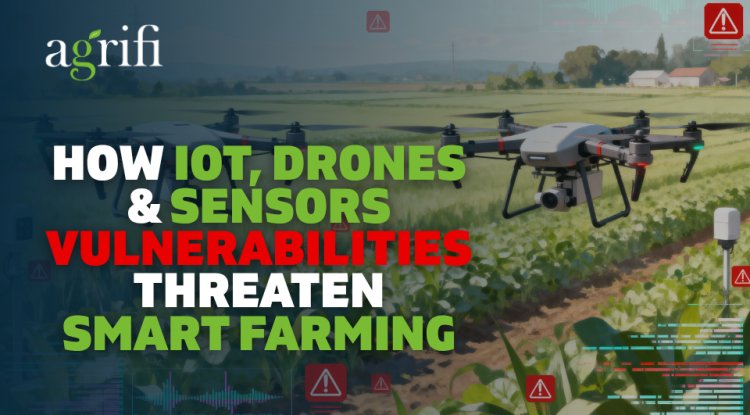
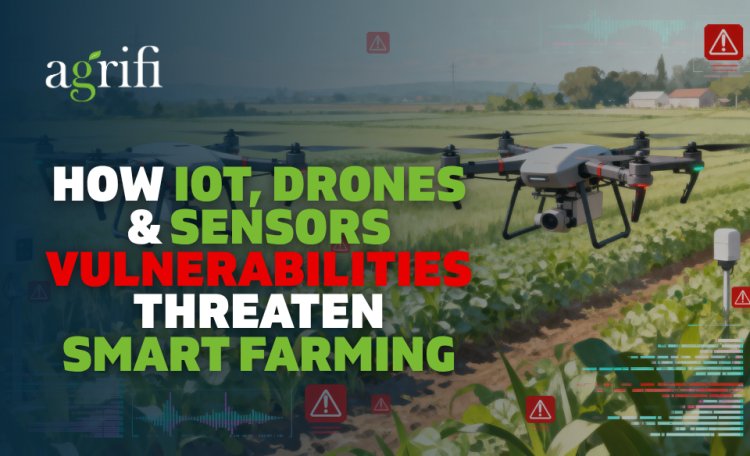
How IoT, Drones & Sensors Vulnerabilities Threaten Smart Farming
Smart farming relies on IoT, drones, and AI-powered sensors, but these innovations bring new cyber risks. Learn how vulnerabilities in IoT devices threaten agriculture and how AgriFi’s blockchain-powered ecosystem ensures secure, tamper-proof farming.
Agriculture today is not just soil, water, and seeds. It’s increasingly powered by networks of sensors, drones, automated tractors, irrigation controllers, and AI-driven analytics. This shift, “Precision Agriculture”, brings efficiency, sustainability, yield boosts, and cost savings.
But with connectivity comes exposure. Each IoT device, each wireless link, is a potential weak point. A compromised soil sensor or a hijacked drone can distort decision-making, sabotage operations, or even trigger crop damage.
It’s urgent to spotlight not just data breaches in finance or enterprise, but how cyberattacks could physically harm farms, food supply chains, and communities.

Modern agriculture is no longer just about soil and seeds; it’s about sensors, drones, AI, and IoT networks that collect and analyze data in real time. Smart tractors navigate with GPS precision, soil sensors deliver nutrient readings, and drones monitor crop health from the sky.
But as farming gets smarter, it also gets more vulnerable. Every new connected device, whether it’s a drone, irrigation controller, or greenhouse monitor, becomes a potential entry point for cyberattacks.
The same technologies helping us grow more food with fewer resources can, if compromised, cause crop failures, financial losses, or food security crises.
1. JBS Ransomware Attack (2021) When Food Becomes Target
While not strictly an IoT device hack, the JBS attack is the poster child for cyber risks in the agri-food sector. On May 30, 2021, JBS, one of the world’s largest meat processors, was hit by a ransomware attack (attributed to REvil / Sodinokibi).
- The attack disrupted plants in the U.S., Canada, and Australia, forcing shutdowns of some facilities for days.
- JBS paid an $11 million ransom in Bitcoin to regain control of IT operations.
- Investigations later revealed that JBS’s cybersecurity posture was weak: many infected endpoints, legacy systems, and slow remediation.
- Lessons highlight how OT/ICT convergence (IT + operations networks) opens the door to attacks on production systems.
Why it matters for smart farming: JBS showed that even when the direct target is a meat processing plant, attackers are eyeing broader agricultural supply chains. IoT links in upstream farms or distribution systems could be the next vector.
2. Smart Irrigation Hack: The “Piping Botnet” Research
An academic proof-of-concept called Piping Botnet revealed a chilling scenario: compromised smart irrigation devices (e.g. RainMachine, GreenIQ) could be used in distributed attacks to manipulate water distribution.
- Attackers can identify a smart irrigation device in a network, then issue spoofed commands to cause overwatering or drain water supply.
- The researchers showed that a botnet of 1,355 sprinklers can empty a standard water tower in just one hour, and 23,866 sprinklers could empty a flood reservoir overnight.
- This is not just a thought exercise; it highlights how agricultural “green tech” can backfire as a weapon.
Implication: Even low-cost climate/irrigation sensors can be turned “inside out” used to disrupt water supply to farms, or as stepping stones into networks.
3. IoT Sensor & Farming Infrastructure Attacks in Literature
A number of technical papers and threat models outline how sensor networks, drones, and smart farming systems are vulnerable:
- A model called STRIDE-based Threat Modeling applied to precision agriculture identified 58 distinct threat points (Spoofing, Tampering, Repudiation, Information disclosure, Denial of Service, Elevation of privilege) in typical IoT-enabled farming systems.
- Research on Autoencoder-based anomaly detection in greenhouse sensor systems showed how malicious data injections can be detected, but only if proper baselines and defenses exist.
- A broader cybersecurity review for precision agriculture (2025) notes that integrity attacks (i.e., falsified sensor data) and side-channel vulnerabilities are key challenges.
- A study titled “Cyber-Security Threats and Side-Channel Attacks for Digital Agriculture” examines overlooked threats: power fluctuation attacks, electromagnetic side-channel leaks, and sensor calibration tampering.
- A review titled “Cybersecurity threats and mitigation measures in agriculture” enumerates vulnerabilities in the edge layer, network layer, and cloud layer; suggests cryptographic defense, lightweight key exchange, and intrusion detection.
- The paper “Cyber Attacks on Smart Farming Infrastructure” describes DoS / DDoS attacks using sensor networks, botnets of IoT, as well as data tampering, man-in-the-middle (MITM) attacks.
These research works validate that the threat space is well known, studied, and real, not speculative.

Why Smart Farming Is Especially Vulnerable
- Time Sensitivity: Farming decisions often happen in real time (irrigation windows, pest control), and delays cost yield.
- Legacy / Low-Security Devices: Many IoT sensors were built cheaply, with default credentials, weak encryption, and outdated firmware.
- Low Cyber Literacy: Farmers or agribusinesses may lack awareness, training, or cybersecurity budgets.
- Wide Attack Surface: Farms have many endpoints (sensors, drones, gateways) often in remote areas.
- IT/OT Convergence: The mixing of administrative networks with control systems opens paths to escalate attacks.
- Supply Chain Links: Vulnerability in one vendor or supplier can cascade into many farms.
- Regulation & Visibility: Agriculture is becoming infrastructure-critical — so attacks will attract regulatory, media, and geopolitical scrutiny.
How IoT, Drones & Sensors Can Be Weaponized
1. Sensor Data Manipulation
- Hackers falsify soil moisture or nutrient readings.
- Farmers irrigate incorrectly; water waste, crop stress.
- AI models predict wrong yields; distorted supply chain planning.
2. Drone Hijacking
- Agricultural drones capture sensitive crop health data.
- Hijacked drones can be stolen, rerouted, or fed false GPS coordinates.
- Attackers could spy on fields or feed fake imagery into analytics.
3. Smart Tractor Exploits
- Vulnerable tractor software can be hijacked.
- Potential to disable harvests, misguide navigation, or cause accidents.
4. Irrigation & Greenhouse Attacks
- Hackers overload water systems, flooding or starving crops.
- Greenhouses hacked to alter climate; crops ruined overnight.
5. Supply Chain Disruption
- Even if farms stay secure, breaches in distribution, storage, or seed genetics can ripple through the food chain.
AgriFi’s Blueprint: Securing Smart Farming
AgriFi integrates IoT, AI, and blockchain to strengthen defense:
1. Immutable Blockchain Records: Every sensor reading is stored tamper-proof.
2. Device Authentication: Only verified drones/sensors can push data.
3. Cross-Validation of Data: Multiple devices must agree before automation triggers.
4. Encrypted IoT Gateways: Stops man-in-the-middle (MITM) attacks.
5. Anomaly Detection AI: Flags unusual soil/drone readings instantly.
6. Smart Contracts for Safety: Prevents rogue commands (e.g., irrigation lockouts if suspicious).
7. Audit Trails & Recovery: Attacks leave a footprint on-chain, aiding response & compliance.
Best Practices & Recommendations (for Farmers, Tech Providers, Policy Makers)
For Farmers / Operators
- Use strong, unique credentials; avoid default usernames/passwords.
- Apply firmware updates promptly (but via secure channels).
- Segment networks: separate sensor networks from general business networks.
- Use anomaly alerts (even simple threshold alarms).
- Educate staff: phishing, social engineering, unauthorized USB use.
For AgriTech Manufacturers / Device Makers
- Design security from day one: secure boot, encrypted storage, over-the-air updates with integrity checks.
- Support cryptographic authentication and firmware signing.
- Limit device privileges (don’t grant excessive rights).
- Use anomaly/health checks to detect abnormal behavior.
- Participate in vulnerability disclosure and audits.
For Policymakers / Regulators
- Recognize agriculture as critical infrastructure and mandate cyber incident reporting, minimal security standards.
- Offer subsidies/incentives for farmers to adopt “secure by design” IoT equipment.
- Promote cybersecurity awareness programs in rural/agricultural communities.
- Facilitate standardization (e.g., secure communication protocols, IoT standards) across agricultural technology.
Smart farming technologies, drones, sensors, and automation bring a transformation in yield, sustainability, and efficiency. Yet they open doors for sabotage, data tampering, and cascading physical damage.
Real attacks (like JBS), threat research (Piping Botnet, STRIDE models, anomaly detection), and documented vulnerabilities show that this is not a hypothetical worry; it’s a real domain of risk.
AgriFi’s approach, integrating IoT with blockchain, designing multi-layer defenses, enabling auditability, and promoting resilience, is one vision of how the agriculture of tomorrow can be both smart and safe.
Don’t just digitize your farm; defend it with the same rigor you use for your crops.
What's Your Reaction?