The Global Coffee Market Is Changing: Why Every Bean Now Needs Better Data
The global coffee market is entering a new phase in 2026, with record production forecasts, shifting commodity prices, climate-related risks, and growing expectations for supply-chain transparency. As coffee moves from farms to international markets, reliable agricultural data is becoming increasingly important. This article examines the latest global coffee production and price trends, emerging traceability requirements, and how AI, IoT, blockchain, and Web3 could support more connected, transparent, and data-driven coffee supply chains. Discover what these developments mean for the future of digital agriculture and AgriFi's vision for connected agricultural ecosystems.
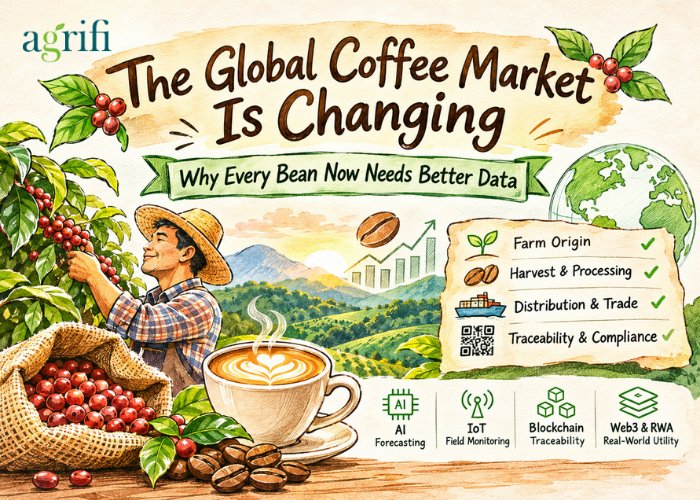
From record production forecasts and shifting coffee prices to traceability requirements, AI, IoT, and blockchain, what 2026 reveals about the future of the coffee supply chain.
A cup of coffee may take only minutes to prepare. The journey behind it can span continents, agricultural seasons, processing facilities, trading networks, and multiple organizations.
In 2026, that journey is becoming more important to understand.
Global coffee production is forecast to reach a record level. Coffee prices have experienced significant changes. Major producing countries are preparing new harvests. Meanwhile, businesses selling into international markets face increasing expectations around origin verification, environmental due diligence, and supply-chain information.
These developments are not separate stories; Together, they reveal an important challenge for the global coffee economy:
The industry needs more than information about how much coffee is produced. It needs reliable, connected information about where coffee comes from, how it moves, and what happens between the farm and the final market.
This is where digital agriculture, artificial intelligence, IoT, and blockchain become relevant not as automatic solutions to agricultural volatility, but as technologies that may support better visibility, traceability, and decision-making.
Global Coffee Production Is Heading Toward a Record, But the Market Remains Complex
According to the USDA's July 2026 Coffee: World Markets and Trade report, global coffee production for the 2026/27 marketing year is forecast to reach 189.7 million 60-kilogram bags.
That would represent an increase of approximately 10.8 million bags from the previous year.
Global consumption is forecast at 179.7 million bags, while ending stocks are expected to rise to 26.3 million bags.
These figures suggest improving aggregate supply availability.
But they do not mean every coffee-growing region faces the same conditions.

Source: USDA Foreign Agricultural Service, July 2026. Figures are forecasts for marketing year 2026/27, expressed in 60-kilogram bags.
Brazil's production is expected to reach a record 71.9 million bags, supported by a rebound in Arabica output.
Vietnam's production is forecast to reach 32.5 million bags, with higher yields and expanded production area contributing to the outlook.
However, weather conditions, harvest timing, inventories, and regional supply differences continue to influence the market.
The key distinction is between global availability and local operational conditions.
A record global harvest does not mean every farmer, exporter, or buyer experiences the same economic outcome.
Coffee Prices Tell a More Complicated Story Than Supply Alone
The International Coffee Organization's Composite Indicator Price averaged 262.18 US cents per pound in September, declining 8.7% from August.
|
Coffee category |
Average price (US cents/lb) |
Change from September |
|
ICO Composite |
261.26 |
−0.3% |
|
Colombian Milds |
337.85 |
+0.5% |
|
Other Milds |
334.99 |
+1.7% |
|
Brazilian Naturals |
294.49 |
+1.5% |
|
Robustas |
164.19 |
−2.0% |
The average was 261.26 US cents per pound, a further decline of 0.3%.
Yet the relatively small change concealed differences between major coffee categories.
Arabica indicators generally increased, while Robusta prices declined.
This divergence matters because coffee is not a single, uniform commodity.
Arabica and Robusta differ in growing conditions, production characteristics, quality specifications, and market demand.
Even within these categories, prices can vary by origin, grade, certification, contract terms, and logistics.
A composite price index is useful for monitoring the wider market, but it cannot describe every transaction.
For agricultural businesses, this reinforces the importance of connecting market information with production and supply-chain data.
Price monitoring alone is not enough to explain operational exposure.
Vietnam's November Harvest Shows Why Timing and Field Information Matter
The latest market developments offer a practical example.
On November 13, 2026, Reuters reported that coffee harvesting in Vietnam's Central Highlands was progressing slowly, with limited volumes of newly harvested beans reaching the market.
Farmers were selling coffee at approximately VND 83,200–83,800 per kilogram.
Traders indicated that more substantial volumes might not reach the market until the following month.
Although heavy rainfall had affected parts of central Vietnam, the main Central Highlands coffee-growing region had not experienced significant disruption at the time of the report.
This illustrates an important distinction.
Expected production and coffee available for immediate delivery are not the same thing.
A country may be forecast to produce a large harvest while buyers still face short-term constraints caused by harvest timing, processing, transportation, or inventory availability.
Better field and operational information can help organizations understand these differences.
For example, connected agricultural systems could combine:
-
Field observations and weather information
-
Harvest progress reports
-
Collection and processing records
-
Warehouse inventory
-
Shipment information
-
Relevant market indicators
Such information may support operational planning, but it cannot guarantee delivery schedules or predict prices with certainty.
Climate Risk Is Making Coffee Intelligence More Important
Coffee cultivation depends on environmental conditions that vary across regions and growing systems.
Temperature, rainfall distribution, soil characteristics, pests, and disease pressures can affect plant development and production.
Extreme weather events may also disrupt harvesting, processing, and transportation.
These challenges make localized agricultural monitoring valuable.
However, the usefulness of technology depends on the specific production environment.

A connected monitoring system might identify a change in soil moisture or flag a field for inspection.
But it should not automatically be assumed to prevent crop damage or increase yield.
Those outcomes require suitable agronomic responses and evidence from real-world deployment.
The goal is to support farmers with more timely and relevant information.
The Coffee Supply Chain Has a Data Problem
Coffee frequently moves through several stages before reaching consumers.
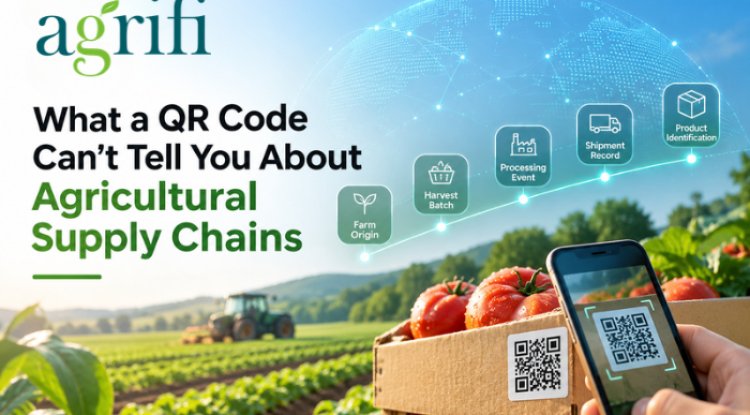
A typical supply chain may include farmers, cooperatives, aggregators, processors, exporters, shipping providers, importers, roasters, and retailers.
Each participant generates information.
But these records may be maintained in different formats and systems.
Consider the questions a coffee buyer might need to answer.
Which farms supplied a particular batch?
Were multiple harvest lots combined during processing?
Which processing facility handled the coffee?
What shipment records are available?
Can the final product be connected to the original production information?
Answering these questions becomes more difficult when product identifiers are inconsistent or records cannot be reconciled.

Coffee Traceability Is Becoming a Market-Access Issue
The European Union's Deforestation Regulation (EUDR) is particularly relevant to the coffee industry.
Coffee is among the commodities covered by the regulation, which establishes requirements concerning deforestation-free products, legal production, and due diligence for relevant operators and traders.
According to the European Commission's current implementation timeline, the regulation is scheduled to apply from December 30, 2026, for medium and large operators, and June 30, 2027, for qualifying micro and small operators, subject to the regulation's specific provisions.
This makes supply-chain documentation increasingly important for businesses operating in affected trade channels.
Relevant information can include production origin, geolocation, supplier details, and evidence required for due diligence.
However, digital traceability and regulatory compliance are not interchangeable.
A blockchain record, digital certificate, or QR code does not independently demonstrate compliance.
Organizations must assess the applicable legal requirements and maintain appropriate verification and due-diligence procedures.
What coffee exporters should evaluate
Origin documentation: Can relevant production locations be identified accurately?
Product identification: Are lots and batches consistently recorded?
Data quality: Can supporting information be checked?
Supply-chain relationships: Can input and output batches be connected through processing?
Information exchange: Can required records be shared with authorized partners?
Regulatory readiness: Do the procedures and records satisfy applicable obligations?
These questions are relevant whether the organization uses conventional software, blockchain infrastructure, or a combination of technologies.
Can Blockchain Make Coffee Supply Chains More Transparent?
Blockchain offers a possible way to maintain tamper-evident references to selected supply-chain records.
For example, a digital system could associate a coffee lot identifier with approved harvest, processing, or shipment events.
Cryptographic hashes or signed records may help participating organizations detect subsequent changes.
However, blockchain cannot independently verify the physical origin of coffee.
If inaccurate information is entered into a system, storing it on-chain does not make it correct.
Reliable traceability therefore requires:
-
Consistent identifiers
-
Appropriate physical-world verification
-
Documented data-entry responsibilities
-
Permission-based information access
-
Clear correction and governance procedures
-
Interoperability with existing business systems
Blockchain is one possible component of this architecture.
It should be selected when shared verification or coordination provides a practical advantage over other approaches.
Where Web3 and Agricultural Real-World Assets Fit
Coffee is part of a physical agricultural economy involving land, crops, inventory, equipment, commercial contracts, and international trade.
Web3 technologies introduce potential mechanisms for representing certain rights or interests digitally.
In principle, legally structured agricultural real-world asset applications could involve eligible asset interests or documented commercial arrangements.
But the economic and legal foundations remain essential.
Tokenizing an agricultural asset does not automatically create ownership rights, liquidity, or investment returns.
Similarly, a blockchain-based representation of coffee inventory does not independently prove that the inventory exists or is unencumbered.
Credible applications require verification, governance, enforceable rights, and appropriate risk management.
For agricultural Web3 projects, the central question is therefore not simply whether an asset can be tokenized.
It is whether the digital representation serves a legitimate, verifiable, and economically useful purpose.
What Coffee Businesses Should Prioritize in 2027
The combination of changing market conditions, traceability requirements, and digital innovation creates several priorities for agricultural stakeholders.
Build reliable origin and batch records
Product identification and source documentation should be consistent across participating organizations.
Improve visibility into harvest and inventory conditions
Field observations, processing records, and stock information can support operational planning when they are timely and accurate.
Connect existing systems before adding new ones
Interoperability can be more valuable than introducing another isolated data platform.
Evaluate AI through measurable use cases
Forecasting and monitoring tools should be tested against relevant operational outcomes.
Treat blockchain as infrastructure, not proof of accuracy
Verification procedures and governance remain necessary.
Assess digital asset models carefully
Any agricultural RWA or Web3 application should have clearly defined rights, responsibilities, and legal foundations.
These priorities reflect a broader shift in digital agriculture.
The objective is not to introduce as many technologies as possible.
It is to make information more reliable and useful across the agricultural value chain.
AgriFi's Perspective: Connecting Agricultural Intelligence With Web3 Infrastructure
At AgriFi, our vision is to explore how AI, IoT, blockchain, and Web3 can support more connected agricultural systems.
The global coffee market provides a relevant example of why these technologies should be considered together.
IoT can help capture selected field information.
AI can support analysis and forecasting.
Digital traceability can connect relevant production and supply-chain records.
Blockchain can support tamper-evident references and multi-party coordination.
Web3 may create opportunities for legally appropriate digital participation and asset-related applications.
Each technology addresses a different need.
The potential value comes from connecting them around real agricultural processes.
For AgriFi, the opportunity is to explore digital infrastructure that supports information integrity, practical agricultural intelligence, and more transparent coordination across the value chain.
Achieving this requires credible data, validation, interoperability, governance, and commercially meaningful applications.
The Future of Coffee Is About More Than the Next Harvest
The global coffee market in 2026 illustrates how production, prices, weather, trade, and regulatory expectations interact.
Record global output forecasts can coexist with regional harvest delays.
A relatively stable composite price can conceal differences between coffee varieties.
And a product with a digital identifier may still lack reliable origin documentation.
These are different challenges, but they share a common requirement: better information.
-
AI cannot eliminate weather uncertainty.
-
IoT cannot guarantee higher yields.
-
Blockchain cannot independently verify the physical world.
-
And Web3 cannot remove agricultural or market risk.
But well-designed digital systems can support more consistent records, more timely information, and better coordination.
The future of coffee will depend not only on how much the world grows, but also on how effectively the industry understands and connects the journey from farm to market.
That is an important direction for the next generation of AgriTech and for AgriFi's vision of connected agriculture.
Explore AgriFi: https://agrifi.tech
FAQ
What is the global coffee production forecast for 2026/27?
The USDA forecast global coffee production at 189.7 million 60-kilogram bags in its July 2026 report. This is a forecast, not a finalized harvest result.
Why are Arabica and Robusta coffee prices different?
They represent different coffee categories with distinct production conditions, quality characteristics, and market dynamics. Supply availability, demand, inventories, and trading conditions can influence their prices differently.
How can AI help coffee farmers?
AI can support analysis of weather, field observations, and crop data for monitoring, forecasting, and decision support. Performance depends on data quality and validation.
Can blockchain verify where coffee comes from?
Blockchain can help preserve records associated with a stated origin, but the original information must be verified through reliable procedures.
What does EUDR mean for coffee exporters?
The EU Deforestation Regulation establishes relevant due diligence and market-access requirements for covered products, including coffee. Obligations depend on the business's role and applicable regulatory provisions.
What is the connection between coffee and agricultural RWAs?
Eligible rights or interests associated with agricultural assets or commercial arrangements may potentially be represented digitally, subject to legal, operational, and verification requirements.
What's Your Reaction?