What a QR Code Can't Tell You About Agricultural Supply Chains
A QR code may provide access to a product's information, but meaningful agricultural traceability depends on what happens behind it. From farm-origin records and harvest batches to processing, transportation, and final product identification, agricultural supply chains generate information across multiple organizations. This article explores why connected records, reliable data, interoperability, and blockchain-enabled verification matter for building more transparent and accountable agricultural supply chains.
A bag of coffee can travel thousands of kilometres before reaching a consumer.
The beans may be grown on one farm, collected by an aggregator, processed at a facility, transported through several logistics networks, and eventually sold under a retail brand.
The physical product follows a supply chain.
But what happens to the information behind it?
Where was it produced? Which harvest batch did it belong to? What happened during processing? Can the final product be connected to reliable records of its origin?
These questions are becoming increasingly important as agricultural businesses face growing expectations around product traceability, environmental due diligence, and supply-chain transparency.
The next competitive challenge in agriculture is not simply producing more information. It is making existing information reliable, connected, and useful.

Why Agricultural Traceability Is Becoming a Business Priority
Agricultural supply chains are complex by nature.
A single product may pass through farmers, cooperatives, processors, transport companies, exporters, importers, and retailers.
Each participant generates information, but the records may be maintained in different formats and systems.
A farmer might record harvest information on paper. A processor may use enterprise software. A logistics provider might maintain separate shipment records. An exporter may need to assemble documents from multiple organizations.
When these records cannot be connected easily, even a straightforward question about product origin can require considerable coordination.
Digital traceability addresses this challenge by connecting information about a product's journey.
It can help organizations identify where products originated, which processing events occurred, how batches were handled, and what information is available for verification.
This is becoming particularly relevant for agricultural exporters navigating evolving market-access requirements.
The 2026–2027 Regulatory Shift: Why Product-Origin Data Matters
The European Union Deforestation Regulation (EUDR) provides an important example of why agricultural supply-chain records are gaining attention.
The regulation covers seven major commodities cattle, cocoa, coffee, oil palm, rubber, soy, and wood along with specified derived products.
Its objective is to reduce the EU market's contribution to deforestation and forest degradation.
For products within scope, applicable operators must meet requirements concerning deforestation-free production, compliance with relevant laws in the country of production, and required due diligence documentation.
Depending on the operator and product, the information involved can include the geolocation of production plots and other evidence supporting due diligence.
Key implementation dates
|
Date |
Application |
|
30 December 2026 |
Large and medium-sized operators and traders, and certain smaller operators previously covered by the EU Timber Regulation |
|
30 June 2027 |
Other micro and small operators |
|
30 December 2027 |
Products newly brought into scope by the 2026 delegated amendment |
These dates reflect the European Commission's published framework as of November 2026. Businesses should verify their specific obligations and monitor official updates.
The significance extends beyond regulatory reporting.
Agricultural businesses increasingly need to consider how origin information, supplier records, and transaction documentation are collected and maintained.
Traceability is becoming part of operational readiness, not merely a consumer-facing marketing feature.
The Hidden Cost of Disconnected Agricultural Records
Fragmented data can create problems at multiple points in the supply chain.
Consider a hypothetical coffee shipment.
A buyer requests documentation linking the exported coffee to its production origin.
The exporter has shipment information, the processor has batch records, and the cooperative has farm-level details.
However, the records use different identifiers.
The exporter must reconcile the information manually.
Even when all the necessary information exists, retrieving and validating it can take additional time.
This illustrates an important distinction:
Data availability is not the same as data traceability.
An effective traceability system must connect records using consistent identifiers, documented events, and clear responsibilities.

These are potential operational differences, not guaranteed outcomes. Their effectiveness depends on implementation quality and participation across the supply chain.
The Food-Loss Problem Adds Another Dimension
Traceability is not only relevant to compliance.
It also forms part of a broader discussion about improving agricultural supply-chain efficiency.
According to FAO's September 2026 reporting, approximately 13.4% of food produced globally is lost after harvest and before reaching retail.
The same report estimates that approximately 19% of food available to consumers is wasted across retail, food service, and households.
These are different measurements covering different stages of the food system.
Food loss can occur during harvesting, storage, transportation, processing, and distribution.
Digital records and monitoring technologies may help organizations understand where losses occur, identify recurring handling problems, and improve operational coordination.
For example, connected temperature monitoring can provide information about storage conditions for temperature-sensitive produce.
Batch-level records can help identify where products were handled or transferred.
However, blockchain or traceability systems do not independently prevent spoilage.
Reducing food loss requires suitable infrastructure, handling practices, logistics, and operational action.
The value of digital information lies in helping stakeholders make better-informed decisions.

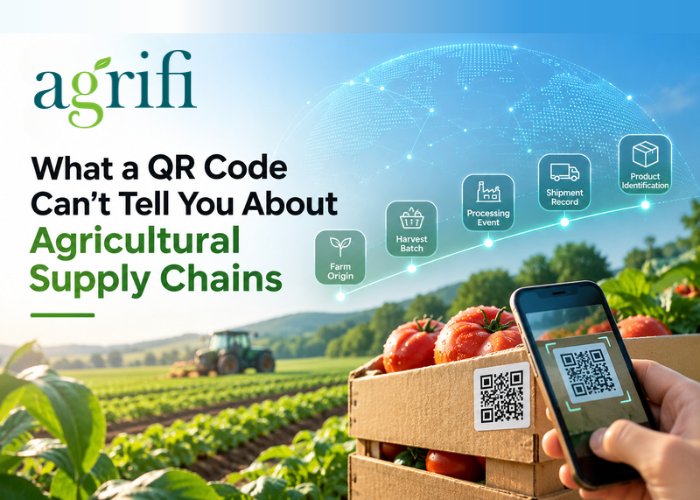
What Does End-to-End Agricultural Traceability Actually Look Like?
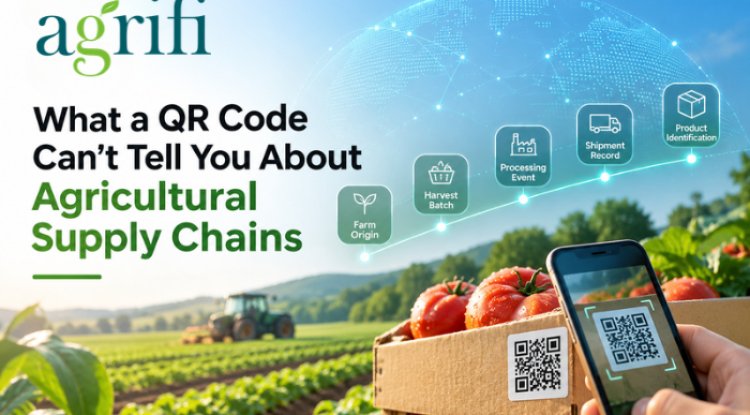
A practical agricultural traceability workflow can be organized around five connected stages.
Stage 1 Farm origin
Record relevant production information, such as the farm identifier, location, crop, and applicable production details.
Stage 2 Harvest batch
Assign identifiers to harvested quantities and record dates, quantities, and relevant batch information.
Stage 3 Processing event
Document how batches are received, transformed, combined, separated, or packaged.
Stage 4 Shipment record
Link the relevant product or batch identifiers with recorded transportation and distribution activities.
Stage 5 Product identification
Connect the final product identifier to the available traceability information.
A QR code may provide access to selected product information, depending on the system and permissions.
The underlying challenge is maintaining reliable relationships between these stages.
For example, if several harvest batches are combined during processing, the system must preserve the relevant input-to-output relationships.
Without this information, a digital product record may appear complete while still failing to establish reliable traceability.
Where Blockchain Fits and Where It Doesn't
Blockchain can support agricultural traceability by maintaining tamper-evident records of selected transactions and events.
In a suitable architecture, participants may record references to product movements, batch identifiers, verification evidence, or other supply-chain information.
This can make unauthorized alteration of recorded information more detectable.
However, blockchain should not be confused with independent verification of physical events.
If inaccurate information is entered into a system, recording it on a blockchain does not make it accurate.
For that reason, effective traceability requires more than distributed ledger technology.
It requires reliable data capture, consistent identifiers, verification procedures, access controls, and clear accountability.
Not every record needs to be stored directly on-chain.
In many architectures, detailed operational information can remain in conventional databases, while selected references or cryptographic hashes are recorded on a blockchain.
This distinction matters for privacy, cost, scalability, and system performance.
Blockchain is one possible component of trustworthy digital infrastructure—not a substitute for trustworthy source data.
Why Interoperability May Matter More Than the Technology Stack
Agricultural supply chains involve organizations with different systems, resources, and technical capabilities.
A traceability platform has limited value if participants cannot exchange information consistently.
Interoperability means that systems can exchange and interpret information using agreed formats and definitions.
For agricultural businesses, this may involve common product identifiers, batch references, event descriptions, and data-sharing procedures.
Standards-based approaches can reduce dependence on proprietary formats and make it easier to connect different systems.
The critical questions are practical:
Can a processor identify which farm batches contributed to a finished product?
Can an exporter retrieve the relevant records?
Can an authorized buyer access the information needed for verification?
Can changes and corrections be documented without losing the record history?
The answers depend as much on governance and data standards as on software architecture.
What Should Agricultural Businesses Prioritize in 2027?
Before investing in digital traceability infrastructure, organizations should assess six areas.
Organizations should begin by identifying the specific information gaps that affect their operations.
A small pilot involving one product category and a defined group of suppliers may help evaluate feasibility before wider deployment.
Success should be measured using operational indicators such as record completeness, retrieval time, reconciliation effort, and the accuracy of batch relationships.
AgriFi's Perspective: Connecting Agricultural Activity With Digital Infrastructure
At AgriFi, blockchain-based traceability forms part of a broader vision for connected agricultural systems.
Agriculture generates valuable information across production, monitoring, processing, and distribution.
The opportunity is to explore how AI, IoT, and blockchain technologies can contribute to more accessible information, consistent digital records, and better coordination.
IoT can support the collection of field and environmental measurements.
AI can help analyze relevant data and identify patterns requiring attention.
Blockchain can support tamper-evident records and controlled information sharing.
Together, these technologies offer possibilities for connecting agricultural activity with digital infrastructure.
However, practical value depends on real-world adoption, reliable information, appropriate governance, and measurable outcomes.
AgriFi's long-term vision is therefore best understood as an exploration of how physical agriculture and emerging digital systems can become more meaningfully connected.
The Future of Food Transparency Depends on the Information Behind the Product
A product can travel across countries, facilities, and commercial networks.
Its information should not become disconnected at every stage.
As agricultural businesses prepare for evolving traceability expectations, the priority is shifting toward reliable origin records, consistent batch identification, interoperable systems, and better information governance.
AI, IoT, and blockchain may support this transition, but none can replace accurate records and responsible operational practices.
The next chapter of agricultural transparency will be defined not by how much data organizations collect, but by how reliably they can connect and use it.
Explore AgriFi's vision for connected agriculture and Web3 infrastructure https://agrifi.tech
FAQ
What is agricultural traceability?
Agricultural traceability is the ability to follow and retrieve information about agricultural products across relevant stages of production, processing, and distribution using linked records and identifiers.
How does blockchain support food traceability?
Blockchain can preserve tamper-evident references to supply-chain events. Its usefulness depends on reliable input data, verification procedures, and integration with operational systems.
What is the EUDR and why does it matter for agricultural exporters?
The EU Deforestation Regulation establishes requirements for specified commodities and products placed on or exported from the EU market. Applicable businesses must meet relevant due diligence requirements, including requirements concerning production origin.
Can QR codes prove where food comes from?
A QR code can provide access to product information, but it does not independently prove that the underlying records are accurate. Reliable traceability depends on the supporting data and verification processes.
Can digital traceability reduce food loss?
Digital traceability can help organizations investigate product movements, handling conditions, and potential sources of inefficiency. Actual food-loss reduction depends on operational changes and supporting infrastructure.
Does agricultural traceability require blockchain?
No. Traceability can be implemented using conventional databases and standardized information systems. Blockchain may be useful where tamper-evident shared records are needed, but it is not universally necessary.
What's Your Reaction?