Beyond Tokenization: Building Real-World Utility for Web3 Agriculture
Explore how agricultural RWAs, blockchain, AI, IoT, and DeFi can connect physical assets with Web3 infrastructure and the risks behind tokenization.
The next phase of Web3 may be defined less by how many assets are tokenized and more by what those tokens actually enable.
Across financial markets, real-world asset (RWA) tokenization is gaining attention as institutions explore how blockchain infrastructure can represent ownership interests, streamline transactions, and support new forms of digital participation. Tokenized financial instruments, including government securities and investment funds, have demonstrated that blockchain-based asset representation can extend beyond cryptocurrencies.
Agriculture presents a different and potentially more complex opportunity.
Unlike conventional financial instruments, agricultural assets are closely connected to physical production, environmental conditions, seasonal cycles, land rights, logistics, and operational risks. A farm cannot be reduced to a digital token without considering the legal, commercial, and physical systems supporting it.
This raises an important question for the emerging agricultural Web3 ecosystem:
Can blockchain technology create meaningful utility around real agricultural activity, rather than simply introducing another digital representation of an asset?
The answer depends on how tokenization, data verification, financial infrastructure, and agricultural operations are connected.
Why Real-World Asset Tokenization Is Moving Beyond Crypto-Native Markets
Tokenization refers to representing certain rights, claims, or interests through digital tokens recorded on a blockchain or another distributed ledger.
In financial markets, this approach is being explored for securities, investment funds, deposits, and other financial instruments.
One significant development is the entry of established financial institutions into tokenized investment products.
In March 2024, BlackRock launched the BlackRock USD Institutional Digital Liquidity Fund, commonly known as BUIDL, using blockchain-based infrastructure.
The significance of this development is not that every asset class will inevitably move on-chain. Rather, it illustrates how blockchain technology is being evaluated for applications involving established financial structures and regulated market participants.
The Bank for International Settlements has also examined how tokenization could influence financial infrastructure, including the representation and transfer of assets and the coordination of financial transactions.
However, tokenization does not automatically improve liquidity, reduce costs, or eliminate intermediaries. Its benefits depend on the underlying legal structure, market design, settlement arrangements, and operational implementation.
These considerations become particularly important when extending tokenization into agriculture.
Agriculture Is a Real-World Economy, Not Just an Asset Category
Agriculture is often discussed in Web3 through farmland tokenization or agricultural commodity-backed tokens.
But the agricultural economy extends well beyond land ownership.
It includes crop production, equipment, storage infrastructure, inventory, transportation, processing, trade, financing, and the information generated across these activities.
Each component has different characteristics.
Farmland may involve long-term property rights and jurisdiction-specific restrictions. Harvested commodities may require quality verification, storage arrangements, and inventory management. Agricultural receivables depend on contractual obligations and counterparty performance.
These differences matter because an agricultural token is only as meaningful as the rights and processes associated with it.
For example, a token linked to farmland does not necessarily provide direct legal ownership of that land.
Depending on its structure, it could represent an interest in a legal entity, a contractual claim, or another defined economic right.
Similarly, a token associated with agricultural production does not automatically entitle its holder to crop revenue or profits.
Such entitlements must be established through valid legal and commercial arrangements.
The underlying asset creates the economic context. The token provides a possible digital representation. The connection between them must be clearly defined and enforceable.
This is one of the most important distinctions in agricultural RWA development.
From Physical Assets to On-Chain Representation
A credible agricultural tokenization model requires several components to work together.
The process begins with identifying the underlying asset or economic interest.
This could involve a legally eligible interest associated with farmland, agricultural inventory, or another defined asset.
The next step is establishing ownership, contractual rights, valuation procedures, and the responsibilities of the parties involved.
Only after these foundations are established can a digital token meaningfully represent the relevant interest.
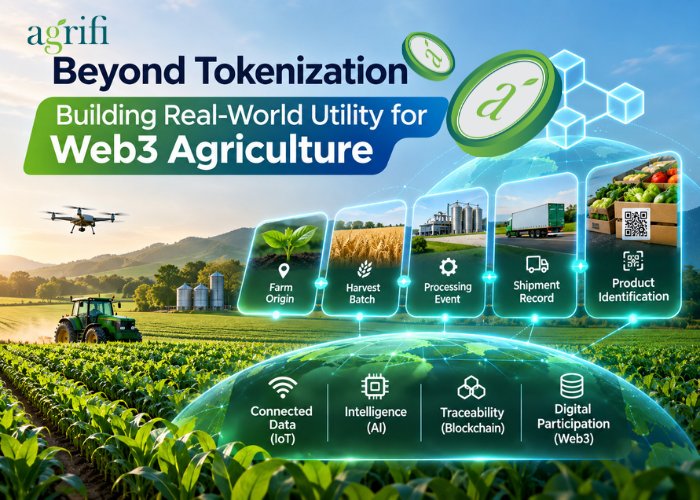
A simplified agricultural RWA structure can be understood through five connected elements:
The relationship between these elements is critical.
A blockchain can record that a token was transferred between two addresses. It cannot independently determine whether the associated farmland exists, whether the issuing entity holds valid rights, or whether a crop has been successfully harvested.
These questions require off-chain verification, legal documentation, and operational oversight.
For agricultural Web3 systems, the challenge is therefore not simply moving assets onto a blockchain.
It is maintaining a reliable connection between digital records and physical economic reality.
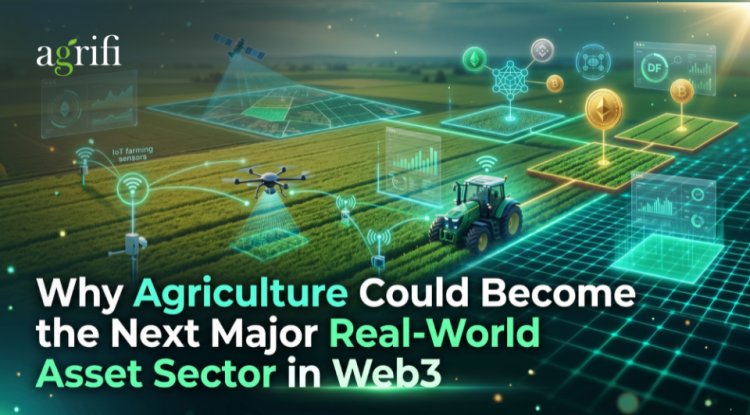
The Role of AI and IoT in Agricultural Web3 Infrastructure
One of the most distinctive characteristics of agriculture is the continuous interaction between physical conditions and economic outcomes.
Weather patterns, soil conditions, crop development, irrigation, and operational activities can influence production.
This makes agricultural data particularly relevant to digital infrastructure.
Internet of Things (IoT) devices can collect information about environmental and operational conditions. Depending on the equipment and deployment, sensors may measure soil moisture, temperature, humidity, or other relevant variables.
Satellite observations and field records can provide additional context.
Artificial intelligence can then help analyze available information for applications such as crop monitoring, yield estimation, anomaly detection, and agricultural risk assessment.
Within a Web3 architecture, selected verified information or references could be connected to blockchain-based records.
For example, a system might associate an agricultural asset identifier with relevant inspection reports, production records, or monitoring information.
However, the use of AI and IoT does not automatically establish the accuracy of an asset's valuation or the reliability of a financial product.
Sensors require maintenance and calibration. AI models require validation. Agricultural data must be interpreted in the context of local conditions.
Blockchain infrastructure can support the integrity of recorded information, but it cannot independently guarantee the truth of external inputs.
This creates an important architectural principle:
Physical data must be verified before it can meaningfully support digital financial applications.
The practical value of AI and IoT in agricultural Web3 may therefore lie in improving information availability, monitoring, and decision support not in replacing human oversight or eliminating agricultural uncertainty.
What Could Decentralized Finance Mean for Agriculture?
Access to finance remains an important challenge across many agricultural markets.
Farmers and agribusinesses often operate within seasonal production cycles, where expenditure occurs before revenue is realized.
Financing needs may include seeds, fertilizer, equipment, irrigation infrastructure, storage, transportation, and working capital.
Traditional financial institutions assess these activities using established credit, collateral, and risk-management processes.
Decentralized finance introduces alternative technical mechanisms for recording and executing certain financial transactions through blockchain-based systems.
In principle, blockchain infrastructure could support applications involving eligible tokenized assets, programmable payment arrangements, and digital participation.
However, agricultural DeFi introduces several complexities.
Agricultural production is exposed to weather variability, pests, disease, commodity-price fluctuations, and logistical disruptions.
These risks cannot be eliminated through smart contracts.
A smart contract can execute a predefined instruction when its conditions are met. It cannot independently confirm the economic performance of a farm unless reliable external information is supplied.
Similarly, automated payment mechanisms do not guarantee that funds will be available or that a borrower will meet their obligations.
The potential role of decentralized finance in agriculture must therefore be evaluated alongside legal compliance, credit risk, asset custody, consumer protection, and the reliability of external data.
The opportunity is not simply to replace traditional agricultural finance with DeFi.
It is to explore where programmable financial infrastructure might complement existing systems and support appropriately structured agricultural applications.
Why Token Utility Matters More Than Token Issuance
A common misconception in Web3 is that introducing a token automatically creates an ecosystem.
In reality, issuing a token is a technical process. Establishing sustainable utility requires a functioning relationship between the token and the activities it is intended to support.
Token utility may be associated with access to services, participation in governance, payment arrangements, or other functions defined by a particular ecosystem.
However, these functions should not be confused with investment returns.
Staking, for example, can serve different purposes depending on the protocol. In some networks, it contributes to transaction validation and security. In other applications, tokens may be locked under program-specific participation rules.
The existence of a staking mechanism does not necessarily imply that rewards are funded by productive economic activity.
Likewise, governance tokens may allow participation in defined decisions, but the extent of governance authority depends on the actual rules and implementation.
For an agricultural Web3 ecosystem, a useful evaluation framework includes three questions.
First, what real activity creates the need for the token?
The relationship between token use and agricultural services or participation should be identifiable.
Second, what does holding or using the token actually enable?
Rights, permissions, restrictions, and potential costs should be clearly documented.
Third, how is the mechanism sustained?
A credible token model requires transparent economic assumptions, defined incentives, and appropriate risk management.
A token does not become economically valuable simply because it is associated with a physical asset or a growing industry.
Its practical utility must be established through actual functionality and adoption.
The Infrastructure Challenge: Connecting On-Chain and Off-Chain Systems
Agricultural Web3 applications operate across two fundamentally different environments.
The physical environment includes farms, land registries, equipment, agricultural operations, legal agreements, and supply-chain relationships.
The digital environment includes blockchain networks, smart contracts, digital identities, asset records, and application interfaces.
Connecting these environments requires reliable processes for exchanging and verifying information.
This is often described as the on-chain/off-chain integration challenge.
For example, a blockchain-based system may require confirmation that a particular agricultural shipment has been delivered.
That confirmation could originate from a logistics system, an authorized inspection process, or another external data source.
A technical mechanism may transmit the information to a smart contract, but the reliability of the resulting action depends on the source and verification process.
This is why agricultural blockchain systems need clear data governance.
Participants must understand who is authorized to submit information, how records are validated, how errors are corrected, and what happens when disputes arise.
Interoperability is equally important.
Agricultural stakeholders frequently use different enterprise systems, databases, and record formats.
A blockchain platform that cannot exchange information with these systems may introduce another isolated data environment rather than solving fragmentation.
Successful integration requires practical standards, appropriate interfaces, and clearly defined responsibilities.
What Makes an Agricultural RWA Model Credible?
The credibility of agricultural tokenization depends on more than technical functionality.
It requires a combination of asset verification, legal clarity, financial transparency, and operational accountability.
Consider the following evaluation framework. These considerations are particularly relevant for agricultural assets because their economic performance may depend on factors outside the control of technology providers.
A crop can fail despite accurate monitoring.
Commodity prices can decline despite reliable traceability.
A tokenized asset can remain illiquid despite being recorded on a public blockchain.
Recognizing these limitations is essential to designing responsible Web3 infrastructure.
AgriFi's Vision: Connecting Agricultural Activity With Web3 Infrastructure
At AgriFi, the opportunity lies in exploring how agricultural activity, connected data, blockchain infrastructure, and digital participation can form part of a broader ecosystem.
Agriculture generates real-world information and economic activity across production, monitoring, processing, and distribution.
AI and IoT can contribute to more informed agricultural monitoring and decision support.
Blockchain can support tamper-evident records, traceability references, and defined digital participation mechanisms.
RWA tokenization and decentralized financial applications may introduce additional possibilities where underlying rights, regulatory requirements, and operational arrangements are appropriately established.
Within this broader vision, the $AGF token represents an area of ecosystem development where practical utility should be evaluated in relation to documented functionality, participation mechanisms, and real-world adoption.
Any specific token rights, staking arrangements, governance permissions, or economic benefits must be defined by the applicable product documentation and implementation.
The long-term opportunity is not simply to introduce blockchain into agriculture.
It is to investigate how physical agricultural activity and digital infrastructure can be connected in ways that are transparent, useful, and operationally credible.
What Comes Next for Agricultural Web3 in 2027?
The development of agricultural Web3 will depend on how effectively projects address the practical challenges that exist beyond token creation.
Several priorities are likely to remain important.
Verified asset foundations. Tokenized agricultural interests require reliable identification, documentation, and appropriate legal structures.
Connected agricultural data. IoT, satellite information, and operational records can support monitoring, but their accuracy and relevance must be evaluated.
Interoperable infrastructure. Blockchain applications need to communicate with the systems used by agricultural businesses.
Responsible financial design. Tokenized participation and financial applications require transparent risk disclosure and compliance with applicable laws.
Measurable utility. The effectiveness of a Web3 ecosystem should be evaluated through actual use, operational outcomes, and the value delivered to participants.
These priorities point toward a more disciplined approach to agricultural blockchain development.
The central question is moving from whether agricultural assets can be represented on-chain to whether doing so solves a meaningful problem.
Real Agriculture Must Come Before Digital Value
Web3 introduces new ways to represent assets, record transactions, coordinate participants, and design digital applications.
Agriculture offers a substantial real-world environment in which these capabilities can be explored.
But tokenization is not a substitute for asset verification. Smart contracts do not eliminate agricultural risk. Blockchain records do not independently establish legal ownership. And digital participation does not guarantee financial returns.
The most meaningful opportunities will emerge where technology is connected to clearly defined rights, reliable data, operational processes, and genuine user needs.
The future of agricultural Web3 will not be determined by how many tokens are created, but by how effectively digital infrastructure serves real agricultural activity.
That is the direction AgriFi is exploring as part of its vision for connected agriculture and decentralized technologies.
Explore AgriFi: https://agrifi.tech
Frequently Asked Questions
What is agricultural RWA tokenization?
Agricultural real-world asset tokenization involves representing defined rights or interests associated with eligible agricultural assets through digital tokens. The legal and economic meaning of a token depends on its underlying structure.
Can blockchain tokens represent farmland ownership?
Tokens may represent certain legally structured interests associated with farmland, but holding a token does not automatically establish direct land ownership. Applicable property laws and contractual arrangements determine the rights involved.
How can AI and IoT support agricultural Web3?
AI and IoT can provide monitoring information and decision support. Relevant verified data may also be connected to blockchain-based records or applications.
What is the role of DeFi in agriculture?
DeFi technologies may support certain programmable financial applications involving eligible agricultural assets or transactions. Their feasibility depends on financial risk, legal requirements, and operational arrangements.
Does agricultural tokenization guarantee investment returns?
No. Tokenization does not guarantee income, asset appreciation, liquidity, or repayment. Agricultural and financial risks remain.
What determines whether a Web3 token has real utility?
Token utility depends on the actual rights, services, permissions, or functions it enables within an operating ecosystem not simply on its existence or association with a physical asset.
What's Your Reaction?